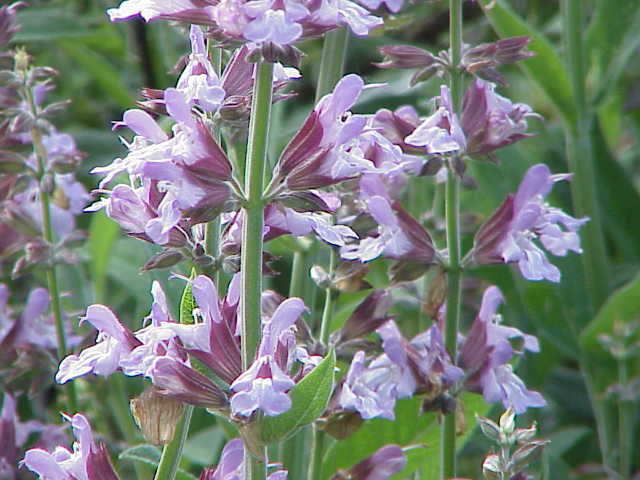
Common sage
Salvia officinalis
The gray-green leaves of a Mediterranean perennial used in European roasts and traditional remedies.
Common sage is a woody Mediterranean shrub grown for its soft, gray-green leaves. The herb carries a savory, slightly peppery taste and has been woven into British, Italian, and Middle Eastern cooking for centuries. It also holds a long place in folk medicine and historical garden cultivation.
- Native to the Mediterranean basin and naturalized worldwide.
- Leaves contain alpha and beta thujone, capped at six milligrams daily.
- Roman priests called it a holy herb used in temple rites.
- Central to British stuffing and Italian saltimbocca.
- Monks stored dried leaves in medieval herbal storerooms.
What is Common sage?
Common sage is a hardy, evergreen subshrub that belongs to the mint family. Its stems turn woody with age, while the oblong leaves measure up to six centimetres long. The upper leaf surface feels rough and gray-green, whereas the underside stays nearly white because of fine soft hairs. Small lavender blossoms appear in late spring or summer, though garden varieties may bloom in white, pink, or purple. The plant gives its name to a pale grayish-green shade. Modern selections often display variegated foliage in cream, yellow, or rose tones.
Where does Common sage come from?
The species originated in the Mediterranean basin before spreading across Europe and beyond. Ancient writers like Theophrastus and Pliny the Elder recorded wild and cultivated forms used as diuretics, skin anesthetics, and blood stoppers. Roman priests called it a holy herb and included it in temple rites. During the early Middle Ages, Emperor Charlemagne ordered monastery gardens to grow it, and monks stored dried leaves in their herbal storerooms. The Latin word officinalis points directly to these old medicinal and culinary stores.
What does Common sage taste like?
The leaves deliver a steady savory backbone with a mild peppery bite. A sweet scent rises when the foliage warms, making it suitable for slow cooking and frying. The sharpness comes from concentrated essential oils, which also contain alpha and beta thujone. That same compound can cause nervous system irritation in high amounts, so historical and modern guides cap daily intake at six milligrams for supplemental use.
How Common sage is grown and processed
Sage thrives in sunny, dry spots with soil that drains well. Cold, wet winters often kill unprotected plants, but healthy cuttings taken in summer root quickly. Some gardeners start new plants from seed, while others buy named cultivars bred for compact size or larger leaves. Certain selections rarely flower, which keeps the foliage usable longer. Distilleries in parts of Europe harvest mature leaves to extract essential oil, sometimes blending them with related species like Salvia fruticosa.
Common sage, drawn
How Common sage is used
Cooking traditions across Europe treat sage as a staple seasoning. In Britain and America, it fills stuffing for roasted poultry during holiday meals and pairs with pork casseroles and regional sausages. Italian kitchens fold it into saltimbocca and fish dishes, or fry whole leaves until crisp for garnish. Balkan and Middle Eastern recipes also call for its savory depth. Historically, cooks prepared cold sage sauces for meat, steeped the leaves for hand-washing infusions, and ground them with salt for dental powders.
Common sage in the world's kitchens
Italian cooking treats sage as an essential partner for meat and seafood, especially in saltimbocca and fried preparations. British and American kitchens anchor it in poultry stuffing and sausage blends, pairing it with fall vegetables. Balkan and Middle Eastern traditions use it to season stews and roasted dishes. French cuisine mentions the herb in older texts but never embraced it as a kitchen staple. Each region adapts the leaf to local meats, seasonal produce, and historic sauce techniques.
At a glance: where it turns up
By meal
Spiritual use


Spiritual and ceremonial use
Ancient Romans dedicated sage to temple rituals and called it a sacred herb. Medieval monks kept dried bundles in monastery storerooms for healing and cooking. The plant appeared in protective mixtures like Four Thieves Vinegar, which people believed guarded against plague. Historical herbals praised its ability to strengthen memory and nerves, weaving it into religious and monastic practices that valued both spiritual purity and physical wellness.
Common sage at celebrations
Sage features prominently on holiday tables in Britain and America. Families pack it into bread stuffing for Christmas and Thanksgiving roasts. Autumn feasts and harvest dinners pair it with squash and root vegetables. Historical cookbooks also record its use in festive poultry dishes and ceremonial sauces served during winter celebrations and seasonal banquets.
Traditional and medicinal use
Folk healers have used sage for centuries to ease mouth inflammation, soothe sore throats, and reduce fevers. Past generations applied it to insect bites, washed hair with it, and took infusions for digestive complaints and nervous tension. Medical authorities note that the essential oil contains thujone, which can trigger convulsions in animals and severe intoxication in humans. Traditional users therefore limit daily consumption to six milligrams of extracted oil.
Buying and storing Common sage
Dried leaves keep their flavor best when sealed away from light and moisture. Whole sprigs should be stored in a cool pantry, while ground foliage loses potency faster. Fresh cuttings last only a few days in the refrigerator unless frozen or dried immediately after harvest. Look for leaves that retain their gray-green hue and snap cleanly rather than feeling brittle or discolored.
What to use instead of Common sage
Rosemary and thyme stand in when sage is unavailable, offering comparable pine-like and peppery notes. Parsley provides a fresher green backdrop but lacks the earthy depth. For those avoiding strong herbal flavors, marjoram or savory can mimic the warm, slightly bitter profile without overwhelming the dish. No single herb replicates sage exactly, so cooks usually blend two milder options to approximate its character.
The trade in Common sage
European growers cultivate sage for essential oil extraction, often mixing it with related species to increase yield. Historical trade routes carried dried leaves through monastery networks and apothecary shops across the continent. Modern markets supply named cultivars bred for ornamental gardens and culinary use. Adulteration remains rare, but buyers should verify botanical labels since other salvia species share similar common names.
Meal
The herb belongs firmly to dinner and feast tables. British and American households serve sage stuffing alongside roast turkey or chicken on Christmas and Thanksgiving. Sunday roasts and autumn dinners featuring pumpkin or squash also rely on its earthy notes. Fried sage leaves finish heavier plates, while historical records show it appearing in medieval cold sauces and poultry preparations served at formal gatherings.
Questions people ask about Common sage
Where does common sage come from?
It originated in the Mediterranean region before spreading to Europe and beyond. Ancient writers recorded both wild and cultivated forms used as diuretics and skin treatments.
What does sage taste like?
The leaves deliver a steady savory backbone with a mild peppery bite. A sweet scent rises when the foliage warms, making it suitable for slow cooking and frying.
How is sage used in cooking?
It fills stuffing for roasted poultry, seasons pork and fish dishes, and finishes plates as fried leaves. Historical recipes also feature cold sage sauces and dental powders mixed with salt.
Is sage safe to eat regularly?
The essential oil contains thujone, which can cause nervous system irritation in high amounts. Health authorities recommend limiting daily supplemental intake to six milligrams.
Good reading and sources
- Salvia officinalis on WikipediaEncyclopedia
- More photos on Wikimedia CommonsPhotos and video
- Wikidata recordOpen data
The facts on this page come from the Wikipedia article "Salvia officinalis", written by its contributors and used under the CC BY-SA 4.0 licence, and from its Wikidata record (CC0). EveryMasala rewrote the text in its own words, with AI assistance, and compares every page with the article to make sure no passage is copied. It may be reused under the same CC BY-SA 4.0 licence with a link back.
It may contain mistakes. Names, strengths and customs differ from one grower, kitchen or shop to the next. Traditional and medicinal uses are described as tradition, never as medical advice, and none of this is a substitute for a doctor. If something is wrong, tell us. Last refreshed 2026-10-04.
More from Italy
All the spices of Italy 🇵🇸 Palestine and 4 moreGreek sage
A hairy Mediterranean shrub with pink flowers and edible fruit galls.Leaf · Herbal and green · Sweet and mellow
🇵🇸 Palestine and 4 moreGreek sage
A hairy Mediterranean shrub with pink flowers and edible fruit galls.Leaf · Herbal and green · Sweet and mellow
 🇮🇹 ItalyPeperoncino
A hot Italian chili pepper used in southern cuisine, dried and crushed for heat.Chilli · Hot and fiery · Sharp and pungent
🇮🇹 ItalyPeperoncino
A hot Italian chili pepper used in southern cuisine, dried and crushed for heat.Chilli · Hot and fiery · Sharp and pungent
 🇪🇸 Spain and 4 moreCaper
The pickled flower buds of a drought-tolerant Mediterranean shrub.Flower · Sharp and pungent · Sour and tart
🇪🇸 Spain and 4 moreCaper
The pickled flower buds of a drought-tolerant Mediterranean shrub.Flower · Sharp and pungent · Sour and tart
 🇬🇷 Greece and 4 moreParsley
A bright green herb from the celery family, used fresh across Europe and the Middle East.Leaf · Bitter · Herbal and green
🇬🇷 Greece and 4 moreParsley
A bright green herb from the celery family, used fresh across Europe and the Middle East.Leaf · Bitter · Herbal and green
Its cousins elsewhere
All leaf 🇮🇳 India and 4 moreBasil
A tender culinary herb with glossy leaves and a licorice-like aroma, native to tropical Asia.Leaf · Anise and liquorice · Warm and sweet-spiced
🇮🇳 India and 4 moreBasil
A tender culinary herb with glossy leaves and a licorice-like aroma, native to tropical Asia.Leaf · Anise and liquorice · Warm and sweet-spiced
 🇷🇺 Russia and 4 moreTarragon
A slender perennial herb with anise-scented leaves, prized in French and Middle Eastern cooking.Leaf · Anise and liquorice · Sweet and mellow
🇷🇺 Russia and 4 moreTarragon
A slender perennial herb with anise-scented leaves, prized in French and Middle Eastern cooking.Leaf · Anise and liquorice · Sweet and mellow
 🇬🇧 United Kingdom and 4 moreRock samphire
A coastal succulent with peppery leaves and carrot-scented roots, used fresh or pickled.Leaf · Hot and fiery · Sharp and pungent
🇬🇧 United Kingdom and 4 moreRock samphire
A coastal succulent with peppery leaves and carrot-scented roots, used fresh or pickled.Leaf · Hot and fiery · Sharp and pungent
 🇺🇸 United States and 5 moreGingermint
A sterile mint hybrid grown for essential oil and chewing gum flavour.Herbal and green · Sweet and mellow
🇺🇸 United States and 5 moreGingermint
A sterile mint hybrid grown for essential oil and chewing gum flavour.Herbal and green · Sweet and mellow