Black cardamom
Amomum subulatum
The dried pod of a Zingiberaceae herb, prized for its smoky, camphor-like flavour in savoury cooking.
Amomum subulatum is a perennial herb grown mainly in Nepal and India. Its pods are dried over open flames to create a strong, smoky taste that suits savoury dishes but rarely sweets.
- Nepal is the world's largest producer.
- Pods are dried over open flames for smoke.
- Used primarily in savoury, not sweet dishes.
- Traditional medicine treats stomach disorders.
- Two distinct species exist across Asia.
What is Black cardamom?
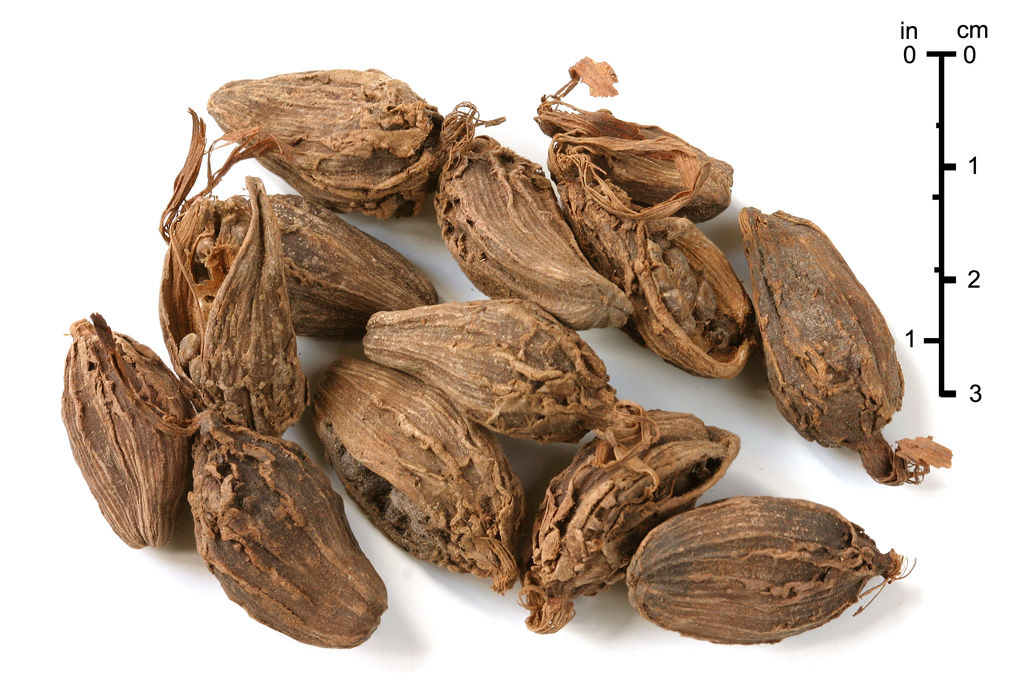
Black cardamom comes from the seed pods of Amomum subulatum, a perennial herb in the ginger family. The pods are dark brown and distinct from their green cousins. They offer a powerful, camphor-like bite with a deep smoky character. This smoke comes from traditional drying methods over open fires. Unlike green cardamom, which often sweetens desserts, black cardamom belongs firmly in savoury cooking. It provides a robust backbone to stews and curries rather than a delicate floral note.
Where does Black cardamom come from?
The spice originates in the Himalayan regions. Nepal stands as the largest producer globally. India follows closely as a major grower. Bhutan also contributes to the harvest. Two main species carry this name. Amomum subulatum grows in South Asia. Lanxangia tsaoko appears in East Asia. The latter features larger pods used in Chinese and Vietnamese kitchens.
What does Black cardamom taste like?
The taste is defined by smoke and pungency. A strong camphor aroma hits the nose immediately. This profile results from drying the pods over open flames. The heat is mild compared to chillies. It adds depth without overwhelming other ingredients. The smokiness lingers on the palate. It pairs well with heavy meats and earthy vegetables.
How Black cardamom is grown and processed
Nepal leads agricultural production. India and Bhutan follow as key growers. Vietnam produces the larger Lanxangia variety. Farmers harvest the pods when mature. The crucial step involves drying over open fires. This process imparts the signature smoky flavour. The pods turn dark brown during curing. They are then stored whole or ground for use.
Black cardamom, drawn
How Black cardamom is used
Cooking uses these pods in savoury dishes. They are often added whole to broths and stews. The pods release flavour slowly during simmering. Chefs remove them before serving. They appear in Pakistani regional cuisine. Sichuan province uses the larger variety extensively. Vietnamese dishes also incorporate the spice. It is rarely found in sweet preparations.
Black cardamom in the world's kitchens
Indian cuisine relies on it for robust curries. Pakistani regional dishes use it similarly. Sichuan cuisine employs the larger Chinese variety. Vietnamese cooking incorporates it into local specialties. The smaller Indian pods differ from the larger East Asian ones. Each region adapts the spice to its own culinary traditions.
At a glance: where it turns up
By meal
Spiritual and ceremonial use
The spice does not appear in sacred texts or offerings. It remains a purely culinary ingredient in daily life.
Black cardamom at celebrations
It is not associated with harvest celebrations or new year events. It serves everyday cooking needs rather than ceremonial purposes.
Traditional and medicinal use
Traditional Chinese medicine uses it for stomach issues and malaria. Nepali and Indian folk medicine treat jaundice with rhizome decoctions. These uses are described as traditional practice only. They are not presented as medical advice or cures.
Buying and storing Black cardamom
Information on shelf life or buying tips is absent.
What to use instead of Black cardamom
Green cardamom is sometimes used similarly but lacks the smoke. The two spices have distinct flavour profiles. Black cardamom cannot be fully replaced in savoury dishes. The larger Lanxangia variety serves as a regional substitute in East Asia.
The trade in Black cardamom
Nepal dominates global production. India and Bhutan are significant exporters. The trade connects South and East Asian markets. Different species serve different regional demands. The spice moves through established agricultural channels.
Meal
This spice fits best into dinner meals. It enhances hearty stews and slow-cooked meats. The smoky notes complement rich sauces. It is not typical for breakfast or snacks. Desserts generally avoid its strong profile. Street food may use it in savoury street snacks.
Blends with Black cardamom
Questions people ask about Black cardamom
Where does black cardamom come from?
It originates in the Himalayan regions. Nepal is the largest producer. India and Bhutan also grow it significantly. A related species grows in Vietnam and China.
What does black cardamom taste like?
It has a strong camphor-like flavour. The taste is distinctly smoky due to fire-drying. It is pungent and robust. It differs greatly from the sweet green cardamom.
How is it used in cooking?
It is used in savoury dishes like stews and curries. Pods are often added whole to broths. It is rarely used in sweets. Sichuan and Vietnamese cuisines use the larger variety.
Good reading and sources
- Black cardamom on WikipediaEncyclopedia
- More photos on Wikimedia CommonsPhotos and video
- Wikidata recordOpen data
The facts on this page come from the Wikipedia article "Black cardamom", written by its contributors and used under the CC BY-SA 4.0 licence, and from its Wikidata record (CC0). EveryMasala rewrote the text in its own words, with AI assistance, and compares every page with the article to make sure no passage is copied. It may be reused under the same CC BY-SA 4.0 licence with a link back.
It may contain mistakes. Names, strengths and customs differ from one grower, kitchen or shop to the next. Traditional and medicinal uses are described as tradition, never as medical advice, and none of this is a substitute for a doctor. If something is wrong, tell us. Last refreshed 2026-10-04.
More from Nepal
All the spices of Nepal 🇮🇳 India and 3 moreLong pepperpippali
The dried fruit spike of a climbing vine, once the world's most prized spice.Fruit · Hot and fiery · Sweet and mellow
🇮🇳 India and 3 moreLong pepperpippali
The dried fruit spike of a climbing vine, once the world's most prized spice.Fruit · Hot and fiery · Sweet and mellow
 🇳🇵 Nepal and 2 moreDalle Khursaniडल्ले खुर्सानी
A round, fiery chilli from the Himalayas, known for its intense heat and vitamin content.Chilli · Hot and fiery
🇳🇵 Nepal and 2 moreDalle Khursaniडल्ले खुर्सानी
A round, fiery chilli from the Himalayas, known for its intense heat and vitamin content.Chilli · Hot and fiery
 🇮🇳 India and 4 moreEast Indian arrowrootകൂവ
A wild South Asian ginger valued for its turmeric-scented foliage and starchy rhizome.Root · Earthy and deep · Herbal and green
🇮🇳 India and 4 moreEast Indian arrowrootകൂവ
A wild South Asian ginger valued for its turmeric-scented foliage and starchy rhizome.Root · Earthy and deep · Herbal and green
 🇮🇳 India and 3 moreGaram masalaगरम मसाला
A ground blend of warm spices from the Indian subcontinent used to finish curries and stews.Blend · Warm and sweet-spiced · Sharp and pungent
🇮🇳 India and 3 moreGaram masalaगरम मसाला
A ground blend of warm spices from the Indian subcontinent used to finish curries and stews.Blend · Warm and sweet-spiced · Sharp and pungent
Its cousins elsewhere
All fruit 🇨🇳 China and 5 moreChili oil辣椒油
A red condiment of infused vegetable oil and hot peppers used across Asia and Europe.Hot and fiery · Smoky
🇨🇳 China and 5 moreChili oil辣椒油
A red condiment of infused vegetable oil and hot peppers used across Asia and Europe.Hot and fiery · Smoky
 🇺🇸 United States and 1 moreNew Mexico chilechile de Nuevo México
A cultivar group of Capsicum annuum from New Mexico, valued for its smoky flavor and range of heat levels.Sharp and pungent · Sweet and mellow
🇺🇸 United States and 1 moreNew Mexico chilechile de Nuevo México
A cultivar group of Capsicum annuum from New Mexico, valued for its smoky flavor and range of heat levels.Sharp and pungent · Sweet and mellow
 🇹🇷 TurkeyUrfa biber
A sun-dried and night-wrapped chili from Turkey with a smoky, raisin-like taste.Chilli · Smoky · Sweet and mellow
🇹🇷 TurkeyUrfa biber
A sun-dried and night-wrapped chili from Turkey with a smoky, raisin-like taste.Chilli · Smoky · Sweet and mellow
 🇦🇹 Austria and 5 moreCaraway
The crescent-shaped fruit of a carrot-family herb, used to flavour breads and spirits.Seed · Anise and liquorice · Sharp and pungent
🇦🇹 Austria and 5 moreCaraway
The crescent-shaped fruit of a carrot-family herb, used to flavour breads and spirits.Seed · Anise and liquorice · Sharp and pungent