
Urfa biber
Capsicum annuum
A sun-dried and night-wrapped chili from Turkey with a smoky, raisin-like taste.
This spice comes from the Urfa region of Turkey, made from landrace Capsicum annuum peppers. It features a smoky, sweet, and complex flavor with moderate heat that builds slowly over time.
- Peppers dry in the sun and wrap at night to develop dark color.
- Heat level sits at 7,500 Scoville units on the scale.
- Name derives from Turkish 'ısı ot' meaning hot weed.
- Held as protected geographic indication in Turkey.
- Flavor resembles smoked raisins with wine-like tannins.
What is Urfa biber?
Urfa biber is a dried chili spice originating in the Urfa area of Turkey. The peppers start as red fruits on the plant but turn a deep maroon, purple, or nearly black color after processing. This unique appearance results from a specific drying technique where the chilies are wrapped tightly at night to retain moisture. The resulting flakes offer a distinct smoky aroma, though no fire is used for smoking. The taste profile combines sweetness reminiscent of raisins with earthy, wine-like notes derived from tannins. It provides a moderate level of heat that lingers longer than many other chili varieties.
Where does Urfa biber come from?
The spice is native to the Urfa region in Turkey, where it has been cultivated for centuries. The name 'isot' likely evolved from the Turkish phrase 'ısı ot,' meaning hot weed, a term documented since the late fifteenth century. While historically local, its international profile rose significantly during the 2010s. This surge occurred because conflicts in Syria disrupted the supply of Aleppo pepper, leading global cooks to adopt Urfa biber as a primary alternative. Today, it holds protected geographic indication status within Turkey under the official name 'Urfa isot pepper.'
What does Urfa biber taste like?
The flavor is defined by a complex interplay of smoke, sweetness, and bitterness. Sun-drying imparts a charred quality without actual smoking. Tannins contribute depth similar to dark chocolate, tobacco, or aged wine. The spice is partially sweet but balanced by acidity and a lingering pungency. Heat levels sit around 7,500 Scoville units, which is mild compared to habaneros but more persistent than standard paprika. The combination creates a savory richness suitable for meat dishes and stews.
How Urfa biber is grown and processed
Harvest occurs between August and October under extreme summer heat reaching 40 to 50 degrees Celsius. Traditional production involves slicing peppers and sun-drying them for a week without overlap. They are then packed into sealed bags for a process called 'sweating,' where they are turned daily and covered at night to trap moisture and darken the flesh. After another week of drying, salt is added to prevent clumping before grinding. Industrial methods use ovens and friction heating to simulate this sweating process faster, often yielding a browner product with fewer natural pigments.
Urfa biber, drawn
How Urfa biber is used
Cooks use Urfa biber to add color and depth to savory dishes. It is a key ingredient in Turkish specialties like çiğ köfte and lahmacun. The flakes are often mixed with cumin, paprika, sesame seeds, or onion powder to create balanced seasoning blends. It works well in meat preparations, soups, and dips. Some producers pickle whole peppers instead of drying them, though these pickled versions rarely leave Turkey for export markets.
Urfa biber in the world's kitchens
Turkish cuisine relies heavily on Urfa biber for its signature savory profiles. The spice defines regional cooking in the Urfa area and surrounding provinces. International adoption grew when Syrian pepper supplies dwindled, making it a staple in Middle Eastern and Mediterranean-inspired kitchens worldwide. Chefs outside Turkey use it to replicate authentic flavors of Anatolian street food and traditional stews.
At a glance: where it turns up
Spiritual and ceremonial use
There are no recorded religious rituals or spiritual ceremonies involving Urfa biber. It is treated strictly as a culinary ingredient rather than a sacred object or offering.
Urfa biber at celebrations
The spice does not have specific ties to weddings, festivals, or harvest celebrations. It is used in everyday cooking and daily meal preparation rather than special occasion dishes.
Traditional and medicinal use
No folk remedies or health claims are associated with the spice.
Buying and storing Urfa biber
Ground flakes should be kept in airtight containers to maintain freshness. Salt is sometimes added during processing to prevent clumping and extend shelf life. The spice remains stable if stored away from direct sunlight and moisture.
What to use instead of Urfa biber
Aleppo pepper serves as the closest substitute, offering similar mild heat and fruity notes. Paprika can mimic the color but lacks the smoky depth. For those seeking heat, cayenne pepper provides intensity but misses the complex sweetness and tannic structure.
The trade in Urfa biber
Turkey produces Urfa biber under protected geographic indication laws. Export volumes increased globally during the 2010s due to supply chain disruptions in neighboring Syria. Traditional processing yields darker, richer flakes with higher carotenoid content compared to industrially produced versions. Adulteration is less common due to strict regional naming protections.
Meal
This spice fits primarily into dinner and snack contexts. It enhances main courses featuring meats, grains, and legumes. In Turkey, it is commonly served with street food and casual meals. The smoky flavor makes it suitable for dipping sauces and spreads eaten throughout the day. It is not typically associated with breakfast or dessert applications.
Questions people ask about Urfa biber
What does Urfa biber taste like?
It tastes smoky and sweet, similar to raisins, with earthy tannin notes resembling wine or chocolate. The heat is moderate and lingers longer than typical chili flakes.
Where does Urfa biber come from?
It originates in the Urfa region of southeastern Turkey. The peppers are grown locally and processed using traditional sun-drying and wrapping methods unique to the area.
How hot is Urfa biber?
It measures approximately 7,500 Scoville Heat Units. This places it in the mild range, comparable to jalapeños, but with a slower-building and longer-lasting pungency.
What is the difference between traditional and industrial Urfa biber?
Traditional batches are sun-dried and night-wrapped, resulting in deep purple-black color and rich flavor. Industrial versions use ovens and friction heating, producing browner flakes with less complexity.
Can I use Urfa biber as a substitute for Aleppo pepper?
Yes, it is widely used as an alternative when Aleppo pepper is unavailable. Both offer mild heat and fruity notes, though Urfa biber has a distinct smokier profile.
Good reading and sources
- Urfa biber on WikipediaEncyclopedia
- More photos on Wikimedia CommonsPhotos and video
- Wikidata recordOpen data
The facts on this page come from the Wikipedia article "Urfa biber", written by its contributors and used under the CC BY-SA 4.0 licence, and from its Wikidata record (CC0). EveryMasala rewrote the text in its own words, with AI assistance, and compares every page with the article to make sure no passage is copied. It may be reused under the same CC BY-SA 4.0 licence with a link back.
It may contain mistakes. Names, strengths and customs differ from one grower, kitchen or shop to the next. Traditional and medicinal uses are described as tradition, never as medical advice, and none of this is a substitute for a doctor. If something is wrong, tell us. Last refreshed 2026-10-04.
More from Turkey
All the spices of Turkey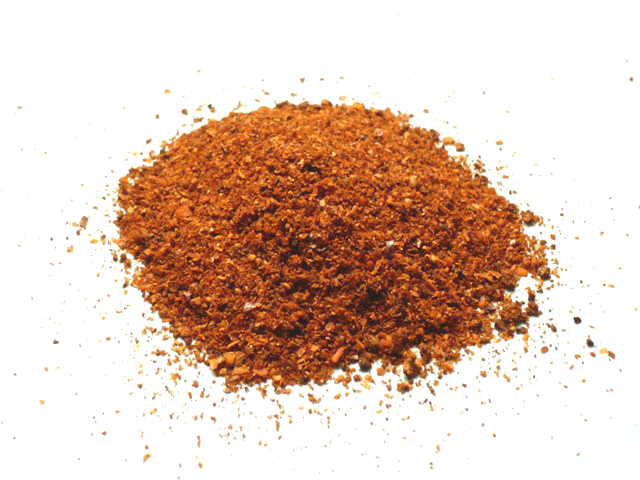 🇸🇾 Syria and 1 moreAleppo pepperفلفل حلبي
A moderately spicy, fruity flake from Syria and Turkey, named for the city of Aleppo.Chilli · Hot and fiery · Sweet and mellow
🇸🇾 Syria and 1 moreAleppo pepperفلفل حلبي
A moderately spicy, fruity flake from Syria and Turkey, named for the city of Aleppo.Chilli · Hot and fiery · Sweet and mellow
 🇬🇷 Greece and 1 moreMasticΜαστίχα
A bitter-sweet resin from the mastic tree, used in desserts and traditional medicine.Bitter · Sharp and pungent
🇬🇷 Greece and 1 moreMasticΜαστίχα
A bitter-sweet resin from the mastic tree, used in desserts and traditional medicine.Bitter · Sharp and pungent
 🇹🇷 Turkey and 2 moreMahleb
A ground cherry seed used to sweeten Middle Eastern baked goods with an almond-cherry note.Seed · Sweet and mellow · Bitter
🇹🇷 Turkey and 2 moreMahleb
A ground cherry seed used to sweeten Middle Eastern baked goods with an almond-cherry note.Seed · Sweet and mellow · Bitter
 🇮🇹 Italy and 2 moreCommon sage
The gray-green leaves of a Mediterranean perennial used in European roasts and traditional remedies.Leaf · Herbal and green
🇮🇹 Italy and 2 moreCommon sage
The gray-green leaves of a Mediterranean perennial used in European roasts and traditional remedies.Leaf · Herbal and green
Its cousins elsewhere
All chilli 🇺🇸 United States and 1 moreNew Mexico chilechile de Nuevo México
A cultivar group of Capsicum annuum from New Mexico, valued for its smoky flavor and range of heat levels.Sharp and pungent · Sweet and mellow
🇺🇸 United States and 1 moreNew Mexico chilechile de Nuevo México
A cultivar group of Capsicum annuum from New Mexico, valued for its smoky flavor and range of heat levels.Sharp and pungent · Sweet and mellow
 🇨🇳 China and 1 moreChenpi陳皮
Sun-dried mandarin orange peel aged for use in Chinese cooking and medicineFruit · Sweet and mellow · Sharp and pungent
🇨🇳 China and 1 moreChenpi陳皮
Sun-dried mandarin orange peel aged for use in Chinese cooking and medicineFruit · Sweet and mellow · Sharp and pungent
 🇱🇰 Sri Lanka and 5 moreCinnamon
The dried inner bark of Cinnamomum trees, prized for its sweet warmth and essential oil.Bark · Warm and sweet-spiced · Sweet and mellow
🇱🇰 Sri Lanka and 5 moreCinnamon
The dried inner bark of Cinnamomum trees, prized for its sweet warmth and essential oil.Bark · Warm and sweet-spiced · Sweet and mellow
 🇬🇷 Greece and 4 moreParsley
A bright green herb from the celery family, used fresh across Europe and the Middle East.Leaf · Bitter · Herbal and green
🇬🇷 Greece and 4 moreParsley
A bright green herb from the celery family, used fresh across Europe and the Middle East.Leaf · Bitter · Herbal and green