🇳🇵 The spices of Nepal
19 spices from Nepal, best known first, across 2 cities, markets and growing areas.
Nepali cuisine relies on dal-bhat-tarkari, a daily trio of lentil soup, rice, and vegetable curry, seasoned with spicy pickles. Regional variations range from Tibetan-influenced dumplings in the high Himalayas to rich, fermented dishes among Newar communities.
- Dal-bhat-tarkari is the standard daily meal across Nepal.
- Momo dumplings originated with buffalo filling but now use goat or chicken.
- Thimur-ko-choup mixes Sichuan pepper, chili, and salt for seasoning.
- Gundruk is fermented mustard greens used in pickles and curries.
- Sel roti is a sweet, ring-shaped rice bread eaten during Tihar.
Spice in Nepal
Cooking in Nepal reflects its diverse geography, from fertile lowlands to cold high mountains. The standard meal is dal-bhat-tarkari, eaten twice daily by many. Influences include Tibetan, Indian, and indigenous traditions. High-altitude areas use buckwheat and millet due to limited farming land. Lowland regions grow rice and vegetables more easily. Trade routes brought ingredients like spices and tea. Communities differ significantly in meat consumption and staple grains based on local climate and culture.
The spices of the kitchen
Seasoning often involves timur (Sichuan pepper), red chili powder, salt, and local herbs. These create timur-ko-choup, a dip for dried meats and eggs. Mustard greens and radish form the base of achaar (pickles). Fresh green chilies and lemon accompany meals. Ginger and garlic are common in curries. Spices are used to balance the heaviness of dairy and meat in mountain diets.
Blends and pastes
Thakali cuisine uses timur-ko-choup, a mix of red chili, Sichuan pepper, salt, and herbs. This blend seasons potatoes, eggs, and dried meats. Achaar varies by region, including gundruk (fermented mustard greens) and radish pickles. Newar cooking features complex spice pastes for marinating buffalo meat. Dal-bhat-tarkari itself acts as a balanced flavor profile of savory, sour, and spicy notes.
Today
Modern kitchens incorporate Chinese-style chow mein as a daily staple. Migration has spread momo and Nepali food globally. Urban centers offer diverse options beyond traditional home cooking. Imported goods supplement local production in remote areas. Protected cultural practices maintain ethnic culinary identities. Tourism supports Thakali inns and local food businesses.
The facts in this overview come from the Wikipedia article "Nepalese cuisine", written by its contributors and used under the CC BY-SA 4.0 licence. EveryMasala rewrote the text in its own words, with AI assistance, and compares every page with the article to make sure no passage is copied. It may be reused under the same CC BY-SA 4.0 licence with a link back.
Spice cities and markets of Nepal
 🇳🇵 Nepal and 2 moreDalle Khursaniडल्ले खुर्सानी
A round, fiery chilli from the Himalayas, known for its intense heat and vitamin content.Chilli · Hot and fiery
🇳🇵 Nepal and 2 moreDalle Khursaniडल्ले खुर्सानी
A round, fiery chilli from the Himalayas, known for its intense heat and vitamin content.Chilli · Hot and fiery
 🇮🇳 India and 4 moreEast Indian arrowrootകൂവ
A wild South Asian ginger valued for its turmeric-scented foliage and starchy rhizome.Root · Earthy and deep · Herbal and green
🇮🇳 India and 4 moreEast Indian arrowrootകൂവ
A wild South Asian ginger valued for its turmeric-scented foliage and starchy rhizome.Root · Earthy and deep · Herbal and green
 🇮🇳 India and 3 moreGaram masalaगरम मसाला
A ground blend of warm spices from the Indian subcontinent used to finish curries and stews.Blend · Warm and sweet-spiced · Sharp and pungent
🇮🇳 India and 3 moreGaram masalaगरम मसाला
A ground blend of warm spices from the Indian subcontinent used to finish curries and stews.Blend · Warm and sweet-spiced · Sharp and pungent
 🇨🇳 China and 5 moreSichuan pepper花椒 (huājiāo)
The dried husk of Zanthoxylum fruit, prized for its citrus scent and electric numbness.Fruit · Citrus and bright · Sharp and pungent
🇨🇳 China and 5 moreSichuan pepper花椒 (huājiāo)
The dried husk of Zanthoxylum fruit, prized for its citrus scent and electric numbness.Fruit · Citrus and bright · Sharp and pungent
 🇮🇳 India and 3 moreBlack saltकाला नमक
A kiln-fired rock salt with a sulphurous aroma used in South Asian cooking and Ayurveda.Sharp and pungent · Sour and tart
🇮🇳 India and 3 moreBlack saltकाला नमक
A kiln-fired rock salt with a sulphurous aroma used in South Asian cooking and Ayurveda.Sharp and pungent · Sour and tart
 🇮🇳 India and 5 moreMustard seed
Tiny seeds from Brassica plants that become a sharp condiment or cooking oil.Seed · Sharp and pungent · Hot and fiery
🇮🇳 India and 5 moreMustard seed
Tiny seeds from Brassica plants that become a sharp condiment or cooking oil.Seed · Sharp and pungent · Hot and fiery
 🇧🇩 Bangladesh and 2 morePanch phoronপাঁচ ফোড়ন
A Bengali blend of five whole seeds used to temper dishesBlend · Bitter · Warm and sweet-spiced
🇧🇩 Bangladesh and 2 morePanch phoronপাঁচ ফোড়ন
A Bengali blend of five whole seeds used to temper dishesBlend · Bitter · Warm and sweet-spiced
 🇧🇷 Brazil and 2 moreBishop's crown
A wrinkled, three-sided Capsicum baccatum cultivar with mild heat and a sweet flavor.Chilli · Sweet and mellow
🇧🇷 Brazil and 2 moreBishop's crown
A wrinkled, three-sided Capsicum baccatum cultivar with mild heat and a sweet flavor.Chilli · Sweet and mellow
 🇳🇵 Nepal and 1 moreJimbu
A dried wild onion herb from the Himalayas, used to season lentils and meat.Leaf · Sharp and pungent · Herbal and green
🇳🇵 Nepal and 1 moreJimbu
A dried wild onion herb from the Himalayas, used to season lentils and meat.Leaf · Sharp and pungent · Herbal and green
 🇨🇳 China and 5 moreGarlic chives韭菜
A flat-leaved Allium with a garlic scent, used across Asia as a herb and vegetable.Leaf · Sweet and mellow
🇨🇳 China and 5 moreGarlic chives韭菜
A flat-leaved Allium with a garlic scent, used across Asia as a herb and vegetable.Leaf · Sweet and mellow
 🇵🇰 Pakistan and 2 moreDundicut
A small, round, dark red chili cultivar from South Asia with moderate heat.Chilli · Hot and fiery · Sharp and pungent
🇵🇰 Pakistan and 2 moreDundicut
A small, round, dark red chili cultivar from South Asia with moderate heat.Chilli · Hot and fiery · Sharp and pungent
 🇮🇩 Indonesia and 5 moreAndaliman
A citrus-scented, tongue-numbing seed husk related to Sichuan pepperFruit · Numbing and tingling · Citrus and bright
🇮🇩 Indonesia and 5 moreAndaliman
A citrus-scented, tongue-numbing seed husk related to Sichuan pepperFruit · Numbing and tingling · Citrus and bright
 🇳🇵 Nepal and 5 moreTimurटिमुर
The dried fruit of a Himalayan shrub, prized for its citrus aroma and numbing tingle.Citrus and bright · Numbing and tingling
🇳🇵 Nepal and 5 moreTimurटिमुर
The dried fruit of a Himalayan shrub, prized for its citrus aroma and numbing tingle.Citrus and bright · Numbing and tingling
 🇮🇳 India and 5 moreIndian bay leafतेजपत्ता
The large, veined leaf of a Himalayan tree, used for its warm cassia scent in South Asian cooking.Warm and sweet-spiced · Sharp and pungent
🇮🇳 India and 5 moreIndian bay leafतेजपत्ता
The large, veined leaf of a Himalayan tree, used for its warm cassia scent in South Asian cooking.Warm and sweet-spiced · Sharp and pungent
 🇨🇳 China and 3 moreZanthoxylum bungeanum
A shrub from China that produces the numbing peppercorns of Sichuan cuisine.Seed · Numbing and tingling
🇨🇳 China and 3 moreZanthoxylum bungeanum
A shrub from China that produces the numbing peppercorns of Sichuan cuisine.Seed · Numbing and tingling
 🇮🇳 India and 3 moreLong pepperpippali
The dried fruit spike of a climbing vine, once the world's most prized spice.Fruit · Hot and fiery · Sweet and mellow
🇮🇳 India and 3 moreLong pepperpippali
The dried fruit spike of a climbing vine, once the world's most prized spice.Fruit · Hot and fiery · Sweet and mellow
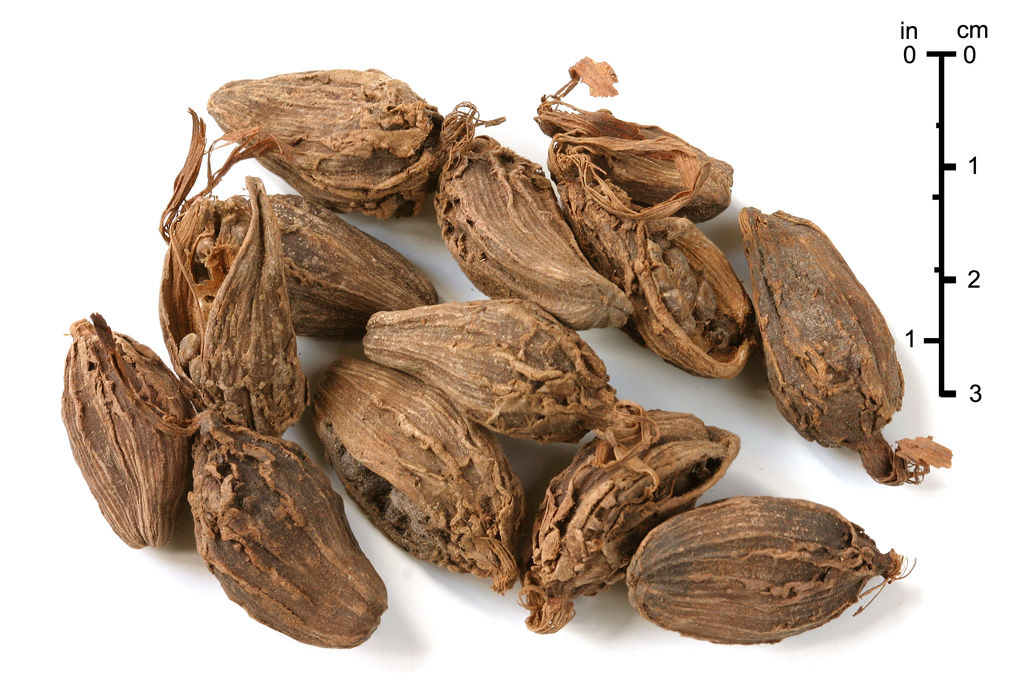 🇳🇵 Nepal and 4 moreBlack cardamom
The dried pod of a Zingiberaceae herb, prized for its smoky, camphor-like flavour in savoury cooking.Fruit · Smoky · Sharp and pungent
🇳🇵 Nepal and 4 moreBlack cardamom
The dried pod of a Zingiberaceae herb, prized for its smoky, camphor-like flavour in savoury cooking.Fruit · Smoky · Sharp and pungent
 🇮🇳 India and 5 moreMustard
The seed of a Brassicaceae plant used to make pungent condiments and oilHot and fiery · Sharp and pungent
🇮🇳 India and 5 moreMustard
The seed of a Brassicaceae plant used to make pungent condiments and oilHot and fiery · Sharp and pungent
 🇮🇳 India and 5 moreMustard seed
Tiny seeds from three Brassica plants that create pungent condiments and cooking oil.Seed · Hot and fiery · Sharp and pungent
🇮🇳 India and 5 moreMustard seed
Tiny seeds from three Brassica plants that create pungent condiments and cooking oil.Seed · Hot and fiery · Sharp and pungent
Photo credits on this page
The small pictures above come from Wikimedia Commons under free licences. Some are cropped to fit.
- Panch phoron: Wiki-uk, CC BY-SA 3.0, source
- Sichuan pepper: Didier Descouens, CC BY-SA 4.0, source
- Indian bay leaf: Sonja Pauen, Public domain, source
- Black salt: Jellyboots ( talk ), CC BY-SA 3.0, source
- Mustard: Taken by Fanghong, CC BY 2.5, source
- Mustard seed: Novalis at en.wikipedia, CC BY-SA 3.0, source
- Jimbu: CJoshi0, CC BY-SA 4.0, source
- Black cardamom: Brian Arthur, CC BY-SA 3.0, source
- Capsicum baccatum: Retama, CC BY-SA 3.0, source
- Timur: Vinayaraj, CC BY-SA 3.0, source
- East Indian arrowroot: Jeevan Jose, Kerala, India, CC BY-SA 4.0, source
- Dalle Khursani: Gaurav Dhwaj Khadka, CC BY-SA 4.0, source
- Long pepper: Unknown author, CC BY-SA 3.0, source
- Garam masala: Miansari66, Public domain, source
- Zanthoxylum bungeanum: Didier Descouens, CC BY-SA 4.0, source
- Dundicut: Rep07, CC0, source
- Andaliman: Daderot, Public domain, source
- Garlic chives: Kurt Stüber [1], CC BY-SA 3.0, source
- Mustard seed: Pancrat, CC BY-SA 3.0, source
The weekly digest
Every Monday: seven spices you may not know, what is cooking this week, and one blend explained step by step.