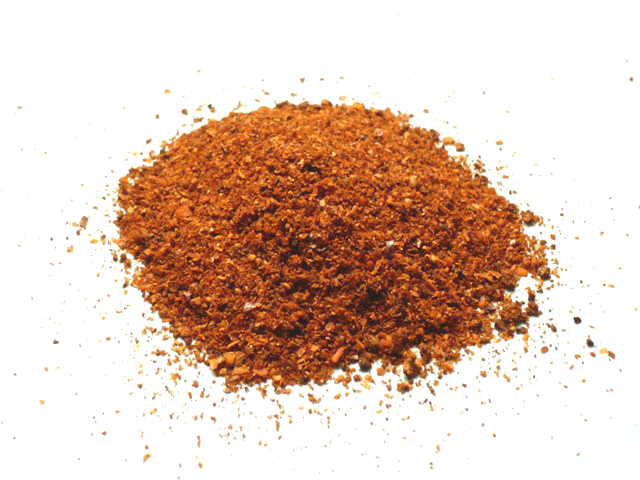
Aleppo pepper
In its own language: فلفل حلبي
Capsicum annuum
A moderately spicy, fruity flake from Syria and Turkey, named for the city of Aleppo.
The Aleppo pepper is a cultivar of Capsicum annuum grown in Syria and Turkey. It produces burgundy pods that are dried and crushed into flakes with a moderate heat and fruity taste.
- Named after the Syrian city of Aleppo on the Silk Road.
- Heat level is approximately 10,000 Scoville units.
- Flakes are de-seeded and have a raisin-like sweetness.
- Known as pul biber in Turkish cuisine.
- Native plant species originates from South America.
What is Aleppo pepper?
This spice comes from the Capsicum annuum plant, a species native to South America. The pods turn a deep burgundy red when fully ripe. They are then semi-dried, de-seeded, and crushed into coarse flakes. The result is a bright red powder or flake that looks similar to paprika but feels oilier to the touch. It carries a moderate heat that builds slowly rather than hitting hard immediately. The flavor profile includes distinct fruity notes reminiscent of raisins or sundried tomatoes, along with mild earthy undertones.
Where does Aleppo pepper come from?
Chiles originated in South America as New World crops alongside potatoes and tomatoes. This specific variety takes its name from the ancient city of Aleppo in northern Syria, a major stop along the historic Silk Road trade route. While named after this Syrian city, the pepper is also widely cultivated in neighboring Turkey. Its use outside of Armenian, Syrian, and Turkish immigrant communities in Europe and the United States remained rare until the twenty-first century.
What does Aleppo pepper taste like?
The heat sits around ten thousand Scoville units, placing it in the moderate range. It shares similarities with the ancho chile but possesses a unique oily texture and a hint of saltiness derived from the drying process. Tasters often describe a round, perfumed sweetness akin to the best sundried tomatoes. The flavor is bright and fruity, lacking the sharp inner flesh bite found in other crushed red peppers because the seeds and pith are removed before grinding.
How Aleppo pepper is grown and processed
Farmers cultivate these plants in Syria and Turkey. Once the pods reach their full burgundy maturity, they undergo a processing stage where they are semi-dried. Salt is frequently added during this drying phase to aid preservation and enhance flavor. After drying, the pods are de-seeded and then crushed or coarsely ground into flakes. This removal of the inner white membrane and seeds ensures the final product remains relatively mild compared to standard crushed red pepper.
Aleppo pepper, drawn
How Aleppo pepper is used
Cooks primarily use the crushed flakes as a condiment or seasoning ingredient. It serves as a common component in meze, the traditional selection of small dishes served in Middle Eastern and Mediterranean cultures. Because of its mild heat and fruity depth, it acts as a suitable substitute for crushed red pepper or paprika in many recipes. Chefs appreciate its ability to add color and a subtle kick without overwhelming other ingredients in a dish.
Aleppo pepper in the world's kitchens
Turkish cuisine relies heavily on this spice, known locally as pul biber. Middle Eastern and Mediterranean cuisines also embrace it as a staple condiment. The flavor profile suits the culinary traditions of these regions, which favor balanced heat and fruity acidity. Its adoption in broader Western kitchens has grown since the mid-nineteen nineties, largely influenced by cookbooks focusing on Eastern Mediterranean food.
At a glance: where it turns up
What to use instead of Aleppo pepper
Cooking guides suggest using crushed red pepper or paprika as direct substitutes when Aleppo pepper is unavailable. While these alternatives provide similar color and basic heat, they lack the specific oily texture and raisin-like sweetness of the authentic flakes. The absence of seeds and inner flesh in Aleppo pepper makes it milder and smoother than typical crushed red pepper blends.
The trade in Aleppo pepper
The spice is named for the historic city of Aleppo, a key hub on the Silk Road. Trade routes facilitated the spread of this cultivar from its South American origins to the Middle East. Today, Syria and Turkey remain the primary growing regions. The spice gained visibility in the United States through culinary publications, notably Paula Wolfert's 1994 book, which introduced the ingredient to a wider audience beyond immigrant enclaves.
Meal
The spice features prominently in snack settings and street-food stalls across its region of origin. In Turkey, it ranks as the third most used spice after salt and black pepper, indicating its daily presence in local cooking. It is frequently sprinkled over meze platters, which function as appetizers or light meals shared among friends and family.
Questions people ask about Aleppo pepper
What does Aleppo pepper taste like?
It offers moderate heat with fruity, raisin-like sweetness and mild earthy undertones. The flavor resembles sundried tomatoes with a subtle salty finish due to the drying process.
Where does Aleppo pepper come from?
The plant species originated in South America. This specific variety is grown in Syria and Turkey and is named after the ancient city of Aleppo in northern Syria.
How hot is Aleppo pepper?
It registers around 10,000 on the Scoville scale. This places it in the moderate heat category, milder than cayenne but hotter than sweet paprika.
What can I use instead of Aleppo pepper?
Crushed red pepper or paprika work as substitutes. However, they may lack the specific oily texture and fruity depth of Aleppo flakes, which are de-seeded and semi-dried.
Good reading and sources
- Bluefish and Aleppo PepperThe New York Times, Article
- How Syria’s Famous Aleppo Pepper Might Be SavedNational Geographic, Article
- Aleppo pepper on WikipediaEncyclopedia
- More photos on Wikimedia CommonsPhotos and video
- Wikidata recordOpen data
The facts on this page come from the Wikipedia article "Aleppo pepper", written by its contributors and used under the CC BY-SA 4.0 licence, and from its Wikidata record (CC0). EveryMasala rewrote the text in its own words, with AI assistance, and compares every page with the article to make sure no passage is copied. It may be reused under the same CC BY-SA 4.0 licence with a link back.
It may contain mistakes. Names, strengths and customs differ from one grower, kitchen or shop to the next. Traditional and medicinal uses are described as tradition, never as medical advice, and none of this is a substitute for a doctor. If something is wrong, tell us. Last refreshed 2026-10-04.
More from Syria
All the spices of Syria 🇱🇧 Lebanon and 5 moreZa'atarزَعْتَر
A Levantine blend of dried herbs, sumac, sesame seeds, and salt used in breads and dips.Blend · Earthy and deep · Citrus and bright
🇯🇴 Jordan and 5 moreBaharatبهارات
A versatile Middle Eastern spice blend used to season meats and soups.Warm and sweet-spiced · Sharp and pungent
🇱🇧 Lebanon and 5 moreZa'atarزَعْتَر
A Levantine blend of dried herbs, sumac, sesame seeds, and salt used in breads and dips.Blend · Earthy and deep · Citrus and bright
🇯🇴 Jordan and 5 moreBaharatبهارات
A versatile Middle Eastern spice blend used to season meats and soups.Warm and sweet-spiced · Sharp and pungent
 🇸🇾 Syria and 5 moreSumac
A tart, crimson spice made from ground berries of the Rhus coriaria shrub.Seed · Sour and tart · Citrus and bright
🇸🇾 Syria and 5 moreSumac
A tart, crimson spice made from ground berries of the Rhus coriaria shrub.Seed · Sour and tart · Citrus and bright
 🇹🇷 Turkey and 5 moreBay Laurelδάφνη
The dried leaf of a Mediterranean evergreen, used to infuse slow-cooked dishes with herbal depth.Sharp and pungent · Bitter
🇹🇷 Turkey and 5 moreBay Laurelδάφνη
The dried leaf of a Mediterranean evergreen, used to infuse slow-cooked dishes with herbal depth.Sharp and pungent · Bitter
Its cousins elsewhere
All chilli 🇮🇳 IndiaChammanthi podi
A dry coconut and spice condiment from Kerala that preserves fresh chutney for months.Hot and fiery · Earthy and deep
🇮🇳 IndiaChammanthi podi
A dry coconut and spice condiment from Kerala that preserves fresh chutney for months.Hot and fiery · Earthy and deep
 🇲🇽 Mexico and 5 morePaprika
A red powder made from dried Capsicum annuum peppers, used to colour and flavour dishes across Europe and the Middle EasSeed · Sweet and mellow · Hot and fiery
🇲🇽 Mexico and 5 morePaprika
A red powder made from dried Capsicum annuum peppers, used to colour and flavour dishes across Europe and the Middle EasSeed · Sweet and mellow · Hot and fiery
 🇵🇪 Peru and 5 moreChili pepperchīlli
The pungent berry of the Capsicum plant, used to add heat to dishes worldwide.Fruit · Hot and fiery · Earthy and deep
🇵🇪 Peru and 5 moreChili pepperchīlli
The pungent berry of the Capsicum plant, used to add heat to dishes worldwide.Fruit · Hot and fiery · Earthy and deep
 🇦🇺 AustraliaWattleseed
The edible seed of Australian Acacia trees, traditionally ground into flour by Aboriginal Australians.Seed · Sweet and mellow · Earthy and deep
🇦🇺 AustraliaWattleseed
The edible seed of Australian Acacia trees, traditionally ground into flour by Aboriginal Australians.Seed · Sweet and mellow · Earthy and deep