
Houttuynia
In its own language: 折耳根
Houttuynia cordata
A heart-shaped herb with a sharp fishy taste used in salads and teas across Asia.
Houttuynia cordata is a perennial herb native to Southeast Asia. Its leaves have a distinct peppery, fish-like flavour from decanoyl acetaldehyde. It is eaten fresh in salads or brewed as tea in East Asian cuisines.
- Contains decanoyl acetaldehyde which gives a fishy taste.
- Rhizomes are staples in Guizhou and Sichuan cuisines.
- Dried leaves brew into popular herbal teas in Japan.
- Extracts are key ingredients in Korean skincare products.
- Spreads aggressively via underground rhizomes.
What is Houttuynia?
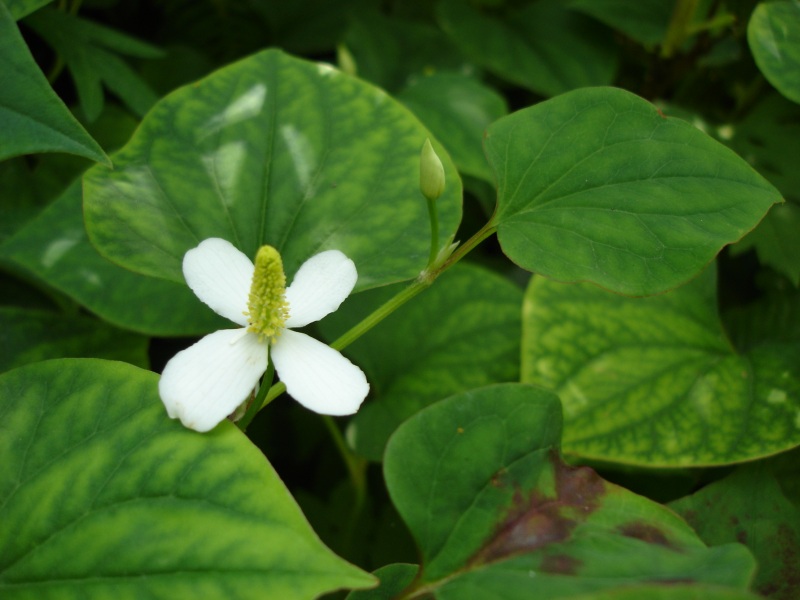
Houttuynia cordata is a flowering perennial herb known by many names including fish mint and chameleon plant. The plant features broad, heart-shaped leaves that grow up to nine centimetres long. A terminal spike holds greenish-yellow flowers surrounded by white bracts. The foliage contains volatile oils that create a sharp, distinctive aroma often compared to fish. This strong scent defines its culinary identity and separates it from common garden herbs.
Where does Houttuynia come from?
The species originates in Southeast Asia. It grows naturally across a wide range of territories including Nepal, India, Myanmar, Indonesia, China, Japan, Thailand, Vietnam, and South Korea. It thrives in moist, shady environments near water sources. The plant was named after the Dutch naturalist Martinus Houttuyn. Its ability to spread via rhizomes allows it to colonize new areas quickly.
What does Houttuynia taste like?
The primary taste comes from decanoyl acetaldehyde, a chemical compound found in the leaves. This creates a pungent, peppery sensation with citrus notes. Many people describe the flavour as distinctly fishy. The roots offer a similar spicy kick but are often milder when cooked. The aroma is herbal and sharp, lingering on the palate. This unique profile makes it a polarizing ingredient for those unfamiliar with it.
How Houttuynia is grown and processed
This herb prefers wet soil or shallow water with partial to full sun exposure. It spreads aggressively through underground rhizomes that can regenerate from small fragments. Gardeners often find it difficult to eradicate once established. Propagation typically occurs through division of the root system. Cultivated varieties like 'Chameleon' feature variegated leaves with yellow and red mottling.
Houttuynia, drawn
How Houttuynia is used
Cooks use the fresh leaves as a garnish or salad ingredient. In northeastern India, they appear in salsas and side dishes. The tender roots are ground into chutneys or cooked with fish curries. In southwestern China, the rhizomes are stir-fried with pork or added to noodle soups. Vietnamese cuisine incorporates the leaves into grilled meat dishes and spring rolls. Dried leaves also serve as an herbal tea base in Japan and Korea.
Houttuynia in the world's kitchens
Sichuan and Guizhou cuisines rely heavily on the rhizomes for their signature spicy crunch. Yunnan recipes utilize both leaves and roots in various preparations. Vietnamese cooking uses the leaves to cut through the richness of grilled proteins. Northeastern Indian traditions incorporate the greens into everyday vegetable mixes. Japanese and Korean cultures prefer the dried leaf form for medicinal teas.
At a glance: where it turns up
By meal
Spiritual use
Celebrations

Spiritual and ceremonial use
The plant holds significance in traditional Chinese medicine systems. Historically, it has been utilized in herbal remedies for various ailments. Practitioners view its properties as beneficial for health maintenance. Its inclusion in Kampo herb lists highlights its role in East Asian medical traditions.
Houttuynia at celebrations
No specific festivals or holidays are directly tied to this herb. It functions primarily as a daily staple rather than a ceremonial item. Its presence in markets reflects regular consumer demand rather than seasonal celebration requirements.
Traditional and medicinal use
Traditional medicine practitioners use the plant for treating respiratory issues and inflammation. Historical records mention its application during disease outbreaks like SARS. Modern research questions the safety and efficacy of these treatments. Injection forms can trigger severe allergic reactions. Consumers should treat these uses as historical practices rather than proven medical advice.
Buying and storing Houttuynia
Fresh leaves require refrigeration to maintain their crisp texture. They wilt quickly if left at room temperature. Dried leaves for tea storage should remain in airtight containers away from moisture. Properly stored dried herbs retain their potency for extended periods.
What to use instead of Houttuynia
No direct substitute replicates the exact fishy-peppery profile. Some cooks attempt to mimic the effect using cilantro mixed with lime juice. However, the unique chemical compounds in Houttuynia cannot be fully replaced. Those sensitive to strong flavours may avoid it entirely.
The trade in Houttuynia
The plant is cultivated locally across its native range. Commercial trade focuses on fresh produce for regional markets. Extracts are processed for the skincare industry in South Korea. Invasive status in some regions limits large-scale agricultural expansion outside Asia.
Meal
The herb appears most frequently in lunch and dinner settings. It serves as a fresh component in cold-tossed salads and noodle dishes. Street vendors may include it in snack preparations alongside grilled meats. Tea versions provide a daily beverage option. It rarely features in breakfast or dessert contexts due to its savory nature.
Questions people ask about Houttuynia
What does Houttuynia taste like?
It has a sharp, peppery flavour with distinct citrus and fish-like notes. This comes from decanoyl acetaldehyde oil in the leaves. The taste is pungent and lingers on the tongue.
Where is Houttuynia originally from?
It is native to Southeast Asia. It grows wild across countries like Vietnam, China, India, and Japan. It prefers moist, shady habitats near water sources.
How is it used in cooking?
Leaves are eaten raw in salads or as garnishes. Roots are stir-fried with pork or added to noodles. It also appears in Vietnamese spring rolls and Indian vegetable dishes.
Is it safe to eat?
Yes, when consumed as food. However, injected extracts can cause severe allergies. Traditional medicinal uses lack robust clinical validation for safety.
Good reading and sources
- Houttuynia cordata on WikipediaEncyclopedia
- More photos on Wikimedia CommonsPhotos and video
- Wikidata recordOpen data
The facts on this page come from the Wikipedia article "Houttuynia cordata", written by its contributors and used under the CC BY-SA 4.0 licence, and from its Wikidata record (CC0). EveryMasala rewrote the text in its own words, with AI assistance, and compares every page with the article to make sure no passage is copied. It may be reused under the same CC BY-SA 4.0 licence with a link back.
It may contain mistakes. Names, strengths and customs differ from one grower, kitchen or shop to the next. Traditional and medicinal uses are described as tradition, never as medical advice, and none of this is a substitute for a doctor. If something is wrong, tell us. Last refreshed 2026-10-04.
More from Vietnam
All the spices of Vietnam 🇹🇭 Thailand and 3 moreThai basilโหระพา
A Southeast Asian herb with purple stems and anise notes, used in curries and soups.Leaf · Anise and liquorice · Hot and fiery
🇮🇩 Indonesia and 3 moreGalangal
The pungent rhizome of the ginger family, essential to Southeast Asian soups and pastes.Root · Sharp and pungent · Warm and sweet-spiced
🇹🇭 Thailand and 3 moreThai basilโหระพา
A Southeast Asian herb with purple stems and anise notes, used in curries and soups.Leaf · Anise and liquorice · Hot and fiery
🇮🇩 Indonesia and 3 moreGalangal
The pungent rhizome of the ginger family, essential to Southeast Asian soups and pastes.Root · Sharp and pungent · Warm and sweet-spiced
 🇮🇩 Indonesia and 5 morePandan
The fragrant leaf of a sterile screwpine, used to scent rice and desserts across Asia.Leaf · Sweet and mellow · Floral and perfumed
🇮🇩 Indonesia and 5 morePandan
The fragrant leaf of a sterile screwpine, used to scent rice and desserts across Asia.Leaf · Sweet and mellow · Floral and perfumed
 🇹🇭 Thailand and 5 moreKaffir limeมะกรูด
The bumpy-skinned citrus fruit and double-leafed shrub of Southeast AsiaFruit · Citrus and bright · Sharp and pungent
🇹🇭 Thailand and 5 moreKaffir limeมะกรูด
The bumpy-skinned citrus fruit and double-leafed shrub of Southeast AsiaFruit · Citrus and bright · Sharp and pungent
Its cousins elsewhere
All leaf 🇭🇹 HaitiEpis
A blended flavor base of peppers, garlic, and herbs essential to Haitian cookingHot and fiery · Sharp and pungent
🇭🇹 HaitiEpis
A blended flavor base of peppers, garlic, and herbs essential to Haitian cookingHot and fiery · Sharp and pungent
 🇨🇳 China and 5 moreShiso紫蘇
A mint-family herb with serrated leaves, used fresh or pickled across East Asia.Leaf · Herbal and green · Sharp and pungent
🇨🇳 China and 5 moreShiso紫蘇
A mint-family herb with serrated leaves, used fresh or pickled across East Asia.Leaf · Herbal and green · Sharp and pungent
 🇲🇽 Mexico and 2 moreEpazoteepazōtl
A pungent leafy herb from the Americas, traditionally used to flavor beans and stews.Sharp and pungent · Citrus and bright
🇲🇽 Mexico and 2 moreEpazoteepazōtl
A pungent leafy herb from the Americas, traditionally used to flavor beans and stews.Sharp and pungent · Citrus and bright
 🇲🇽 Mexico and 2 morePápalo
A pungent herb from central Mexico to the Andes, used fresh in salsas and tacos.Leaf · Citrus and bright · Sharp and pungent
🇲🇽 Mexico and 2 morePápalo
A pungent herb from central Mexico to the Andes, used fresh in salsas and tacos.Leaf · Citrus and bright · Sharp and pungent