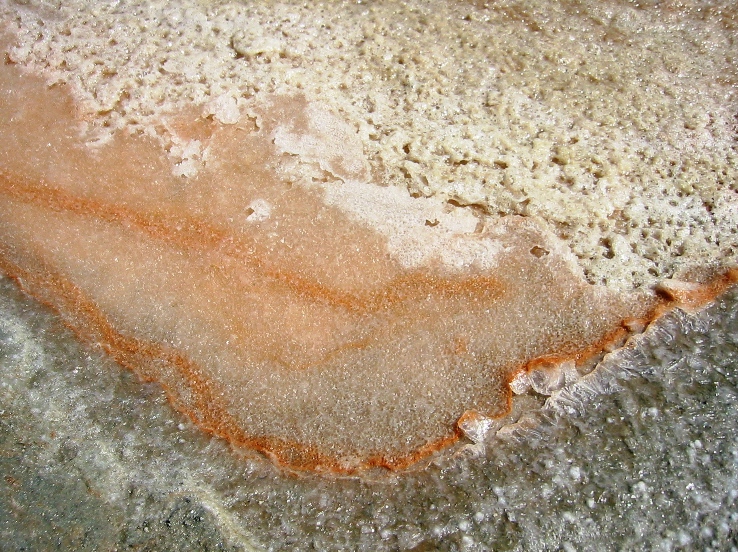
Fleur de sel
A hand-raked crust of sea salt crystals gathered from evaporation pans.
This delicate salt forms as a thin layer on top of evaporating seawater. It is traditionally harvested by hand in France and Portugal, offering a complex mineral taste and a crunchy texture for finishing dishes.
- Crystals form a floating crust on evaporating seawater.
- Harvested by hand using traditional wooden rakes or sieves.
- Contains up to 10% moisture, giving it a clumpy texture.
- Used as a finishing salt for flavor and crunch.
- Produced in small quantities requiring sunny, dry weather.
What is Fleur de sel?
Fleur de sel is a specialty salt that appears as a fragile crust on the surface of seawater. Unlike common table salt, which settles at the bottom of evaporation pans, these crystals float upward. The name translates to "flower of salt," likely referring to the flower-like patterns the pyramidal crystals form or the surface layer itself. The texture is coarse and moist, holding together in clumps rather than flowing freely. It carries a briny, oceanic flavor derived from trace minerals like magnesium and calcium chloride, which are left behind during the slow evaporation process.
Where does Fleur de sel come from?
The practice of collecting this salt dates back to ancient times, with records from Pliny the Elder noting its existence. For centuries, it was primarily gathered in France, particularly along the Atlantic coast. In other regions, such as Portugal, the crust was often scraped away because it interfered with the production of bulk sea salt. Its status as a gourmet item grew slowly, with commercial harvesting in places like Portugal only resuming in the late twentieth century after being largely ignored for generations.
What does Fleur de sel taste like?
The taste is distinctly salty but more complex than refined sodium chloride. The presence of natural minerals gives it an earthy, briny profile that reflects the specific marsh where it was grown. Because it contains up to ten percent moisture, the crystals dissolve slowly on the tongue, releasing a burst of flavor. The color varies from pure white to pale gray or faint pink, depending on local algae and clay content, which also subtly influences the mineral notes.
How Fleur de sel is grown and processed
Harvesting requires precise weather conditions: bright sun, low humidity, and gentle winds. Workers use traditional tools to skim the floating crust without disturbing the water below. In France, collectors known as paludiers use a wooden rake called a lousse à fleur. Portuguese harvesters may use a butterfly-shaped sieve called a borboleta. The collected salt is placed in special boxes to dry in the sun before packaging. This labor-intensive method yields very small amounts, often just one kilogram per marsh daily.
Fleur de sel, drawn
How Fleur de sel is used
Chefs use this salt as a finishing agent rather than a cooking ingredient. It is sprinkled over dishes just before serving to add crunch and enhance flavor. Common applications include garnishing eggs, fish, grilled meats, and vegetables. It is also used on sweet items like chocolate and caramel to create a contrast between sweet and savory. Because of its high cost and delicate texture, it is rarely used for general seasoning or preservation.
Fleur de sel in the world's kitchens
French cuisine holds the strongest association, particularly with the Guérande region, where the salt has been produced for centuries. Portuguese cuisine utilizes flor de sal, especially from the Algarve and Aveiro districts, often noting a robust Atlantic flavor. Spanish producers in Catalonia and the Canary Islands have revived traditional methods, while Greek harvesters in the Mani Peninsula maintain ancient practices. Mexican and Brazilian producers also contribute, with Mexican varieties tracing roots to Aztec and Mayan traditions.
At a glance: where it turns up


Spiritual and ceremonial use
Historically, fleur de sel was believed to have medicinal properties, used as a purgative or applied as a salve. However, there are no significant religious rituals or spiritual offerings tied specifically to this salt in modern practice. Its historical value lay in its rarity and perceived health benefits rather than ceremonial use.
Fleur de sel at celebrations
There are no specific festivals or celebrations dedicated exclusively to fleur de sel. Its production is tied to seasonal weather patterns rather than cultural holidays. While salt itself plays roles in various cultural traditions globally, this specific variety is not highlighted in wedding, birth, or harvest ceremonies in the provided sources.
Traditional and medicinal use
Traditional uses included applying the salt as a topical salve or consuming it as a digestive aid. These practices are rooted in folk medicine and are not recommended as medical advice today. The harvesting technique itself is a traditional craft passed down through generations of salt workers, emphasizing manual skill over mechanical efficiency to preserve the integrity of the crystals.
Buying and storing Fleur de sel
Due to its high moisture content, fleur de sel should be stored in a dry place to prevent clumping. It does not have a long shelf life compared to refined salts and may harden if exposed to humidity. Consumers should look for brands that package the salt in airtight containers to maintain its delicate texture and prevent contamination from external elements.
What to use instead of Fleur de sel
Maldon sea salt is often suggested as a substitute due to its similar flaky texture and mild flavor. However, it lacks the specific mineral complexity and moisture content of true fleur de sel. Other finishing salts can provide crunch but will not replicate the unique briny taste derived from the specific marsh environments where fleur de sel is grown.
The trade in Fleur de sel
The trade in fleur de sel is driven by its scarcity and labor-intensive production. Historically, French exports dominated the market, but Portuguese and Spanish producers have expanded global availability. The high cost results from the small yields and manual harvesting required. Certification and geographical indications help protect traditional methods, ensuring that products labeled as fleur de sel meet specific quality standards related to origin and processing.
Meal
This salt is typically associated with dinner and upscale dining experiences. It serves as a final touch to main courses, elevating simple ingredients through texture and mineral depth. It is occasionally found in snack contexts, such as paired with bread or cheese, but is less common in breakfast or lunch settings due to its premium price point and specialized role as a garnish.
Questions people ask about Fleur de sel
What is fleur de sel?
It is a delicate salt crust that forms on the surface of seawater as it evaporates. Harvested by hand, it features pyramidal crystals and a moist texture, offering a complex, briny flavor used to finish dishes.
Where does fleur de sel come from?
It originates primarily from France, particularly the Guérande region. It is also harvested in Portugal, Spain, Croatia, Mexico, and Brazil, where specific coastal marshes provide the ideal conditions for its formation.
How does it taste?
It tastes salty with earthy, mineral notes derived from trace elements like magnesium and calcium. The high moisture content allows it to dissolve slowly, enhancing the natural flavors of food without overwhelming them.
Why is it so expensive?
The high cost stems from the difficult, manual harvesting process and the small quantities produced. Each marsh yields only about one kilogram per day under perfect weather conditions, making it a labor-intensive luxury product.
How should I use it?
Use it as a finishing salt by sprinkling it over dishes just before serving. It pairs well with eggs, fish, meat, vegetables, and even desserts like chocolate, adding a satisfying crunch and burst of flavor.
Good reading and sources
- Fleur de sel on WikipediaEncyclopedia
- More photos on Wikimedia CommonsPhotos and video
- Wikidata recordOpen data
The facts on this page come from the Wikipedia article "Fleur de sel", written by its contributors and used under the CC BY-SA 4.0 licence, and from its Wikidata record (CC0). EveryMasala rewrote the text in its own words, with AI assistance, and compares every page with the article to make sure no passage is copied. It may be reused under the same CC BY-SA 4.0 licence with a link back.
It may contain mistakes. Names, strengths and customs differ from one grower, kitchen or shop to the next. Traditional and medicinal uses are described as tradition, never as medical advice, and none of this is a substitute for a doctor. If something is wrong, tell us. Last refreshed 2026-10-04.
More from France
All the spices of France 🇫🇷 France and 1 moreDijon mustardMoutarde de Dijon
A sharp condiment made from brown mustard seeds and white wine or verjuice, originating in Burgundy.Sharp and pungent · Sour and tart
🇫🇷 France and 1 moreDijon mustardMoutarde de Dijon
A sharp condiment made from brown mustard seeds and white wine or verjuice, originating in Burgundy.Sharp and pungent · Sour and tart
 🇮🇹 Italy and 5 moreMustard
A pungent paste made from ground mustard seeds mixed with liquid and spices.Paste · Sharp and pungent · Hot and fiery
🇮🇹 Italy and 5 moreMustard
A pungent paste made from ground mustard seeds mixed with liquid and spices.Paste · Sharp and pungent · Hot and fiery
 🇫🇷 France and 3 moreHerbes de Provenceèrbas de Provença
A dried herb blend from southwestern France, now a global kitchen staple.Warm and sweet-spiced · Herbal and green
🇫🇷 France and 3 moreHerbes de Provenceèrbas de Provença
A dried herb blend from southwestern France, now a global kitchen staple.Warm and sweet-spiced · Herbal and green
 🇫🇷 France and 1 moreEspelette pepperpiment d'Espelette
A mild Basque chili with sweet, fruity notes and protected origin status.Chilli · Sweet and mellow · Hot and fiery
🇫🇷 France and 1 moreEspelette pepperpiment d'Espelette
A mild Basque chili with sweet, fruity notes and protected origin status.Chilli · Sweet and mellow · Hot and fiery
Its cousins elsewhere
 🇵🇪 Peru and 5 moreChili pepperchīlli
The pungent berry of the Capsicum plant, used to add heat to dishes worldwide.Fruit · Hot and fiery · Earthy and deep
🇵🇪 Peru and 5 moreChili pepperchīlli
The pungent berry of the Capsicum plant, used to add heat to dishes worldwide.Fruit · Hot and fiery · Earthy and deep
 🇮🇷 Iran and 4 moreSaffronزعفران
The dried crimson stigmas of the autumn-blooming saffron crocus.Stigma · Sharp and pungent · Bitter
🇮🇷 Iran and 4 moreSaffronزعفران
The dried crimson stigmas of the autumn-blooming saffron crocus.Stigma · Sharp and pungent · Bitter
 🇱🇾 Libya and 1 morePilpelchumaפלפלצ'ומה
A steamed chili and garlic paste from Libyan Jewish cuisine, now common in Israel.Hot and fiery · Sharp and pungent
🇱🇾 Libya and 1 morePilpelchumaפלפלצ'ומה
A steamed chili and garlic paste from Libyan Jewish cuisine, now common in Israel.Hot and fiery · Sharp and pungent
 🇮🇳 IndiaChammanthi podi
A dry coconut and spice condiment from Kerala that preserves fresh chutney for months.Hot and fiery · Earthy and deep
🇮🇳 IndiaChammanthi podi
A dry coconut and spice condiment from Kerala that preserves fresh chutney for months.Hot and fiery · Earthy and deep